





Why Do Kilns Need Both SiC Plates and SiC Tubes?
If you've ever walked through a modern ceramics plant or a powder metallurgy facility, you've likely seen these large, heavy plates gliding through tunnel kilns and rows of tubes running along the heating zones. Both are likely made of silicon carbide. This ceramic can survive extreme temperatures that would soften or warp most other materials.
At Advanced Ceramic Materials (ACM), we manufacture silicon carbide plates and tubes, and we often get asked: what's the real difference, and why can't one do the job of the other?
The short answer is: it all comes down to its role.
What SiC Plates and Tubes Have in Common
Let's start with what they share.
Silicon carbide is well-suited for high-temperature environments. Its thermal conductivity—roughly 120 to 160 W/m·K at room temperature. Combine that with a thermal expansion coefficient of just 4.0 to 4.8×10⁻⁶/K, and you get outstanding thermal shock resistance. Plates and tubes made from SiC can withstand repeated, rapid heating and cooling cycles without cracking, which is a daily reality in most production kilns.
Take strength, for example. Even above 1400°C, SiC holds its shape and resists creep—the kind of slow sagging that causes many metals and oxide ceramics to fail under long-term load. Then there's corrosion. SiC stands up to most acids, alkalis, and even molten materials, so you don't have to worry about your kiln furniture falling apart in aggressive process atmospheres.
So if the material is the same, what drives the choice between a plate and a tube?
What Plates Actually Do
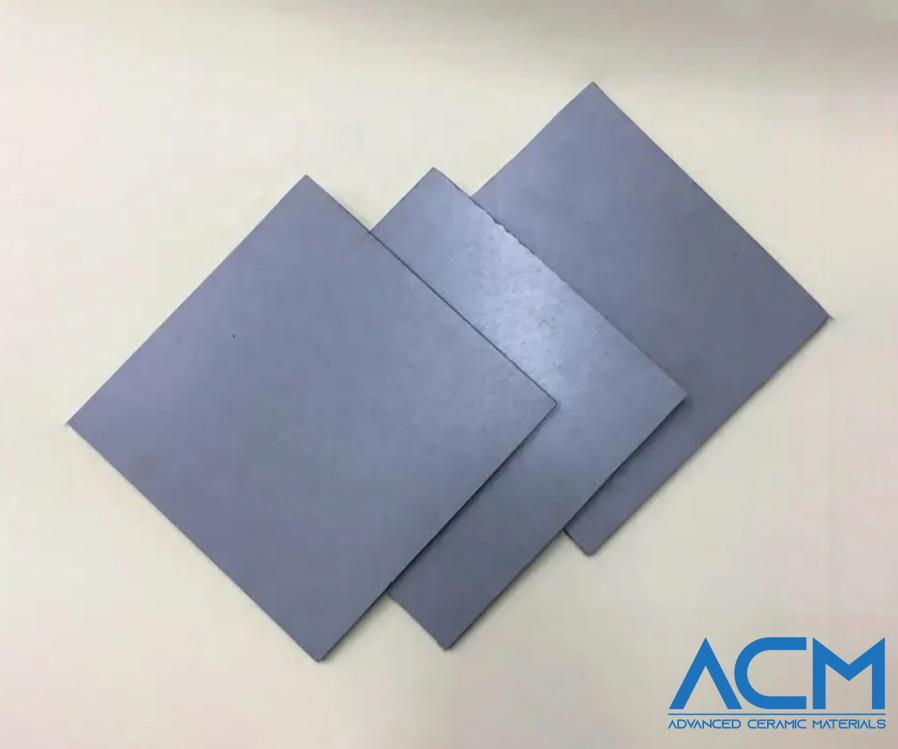
A silicon carbide plate—whether it's called a setter plate, a shelf, or a bat—exists to support products during firing. It bears the weight of the parts being processed, sometimes stacked several layers high.
That means the most critical property isn't just strength at room temperature, but hot strength over time. Creep resistance becomes the deciding factor. A plate that sags or warps under load at 1350°C isn't just a failed component; it can ruin entire batches and even damage the kiln itself.
Good plates also incorporate design features that minimize contact area with the product—such as small ribs, dimples, or slots—to reduce the risk of reactions or sticking at high temperatures. These same features allow heat and atmosphere to circulate freely around the workpiece.
What Tubes Actually Do
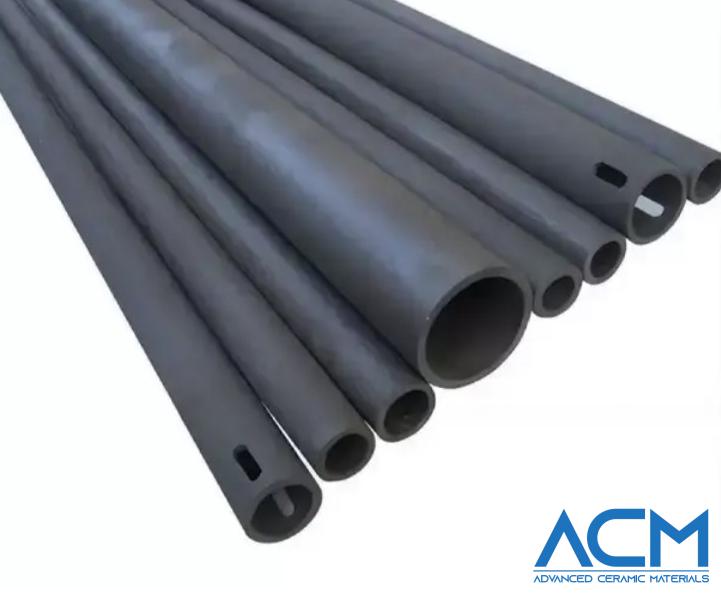
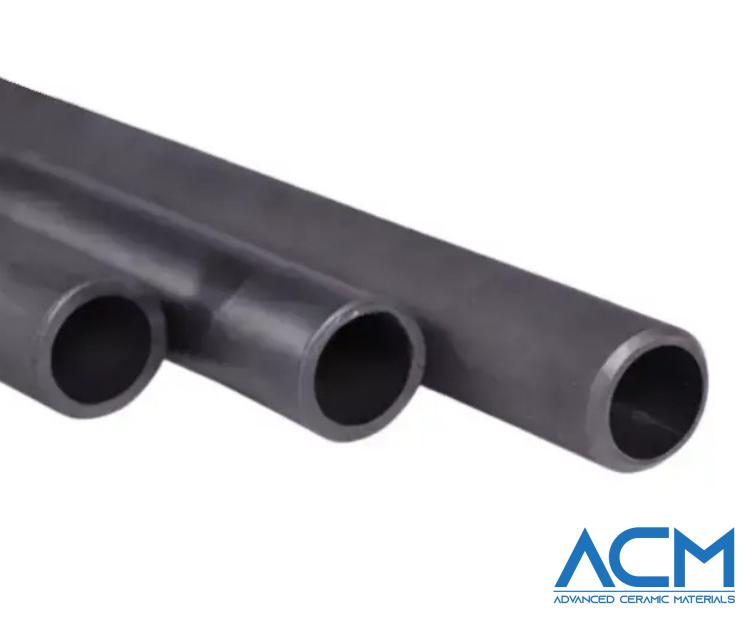
A silicon carbide tube might serve as a radiant heating tube, a thermocouple protection sheath, or a gas delivery line. Its job is to isolate—to keep the internal atmosphere separate from the external, or to protect sensitive elements from direct exposure to the firing zone.
For tubes, gas-tightness is non-negotiable. A micro-crack or a pinhole can compromise the entire furnace atmosphere, leading to oxidation of parts intended to be sintered in a reducing environment or contamination of a sensitive process. Round cross-sections are standard because they distribute stress evenly under both internal and external pressure—a simple but elegant engineering principle.
How They Work Together
In a well-designed kiln, plates and tubes work together, not against each other.
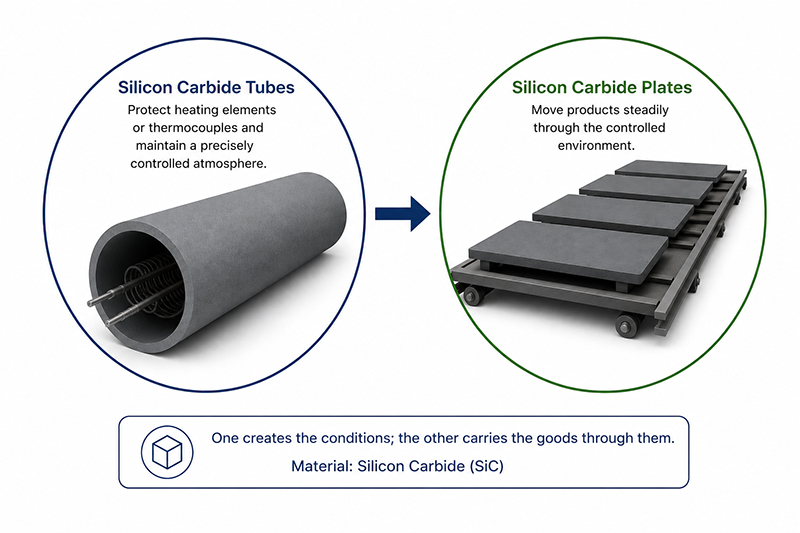
The tubes ensure that heating elements or thermocouples are protected and that the internal atmosphere remains precisely controlled. The plates, riding on kiln cars or conveyor systems, move products steadily through that controlled environment. One creates the conditions; the other carries the goods through them.
It's this partnership that makes modern continuous furnaces possible. And because both components are exposed to the same harsh conditions, their long-term reliability depends on the same fundamental qualities: material purity, consistent microstructure, and careful quality control throughout manufacturing.
What to Look for When Choosing a Supplier
When sourcing silicon carbide kiln furniture, not all suppliers are equal. The differences show up in performance—and in unexpected downtime.
At Advanced Ceramic Materials, we produce both reaction-bonded SiC (SiSiC) and pressureless sintered SiC (SSiC), depending on the application. SiSiC offers an excellent balance of cost and performance for most industrial furnaces. SSiC, with its higher purity and superior corrosion resistance, is the go-to choice for semiconductor and high-end electronics applications where contamination cannot be tolerated.
We pay close attention to the details that make or break performance:
- For plates: flatness, dimensional stability, and verified creep data at operating temperatures
- For tubes: wall thickness consistency, straightness, and pressure-test integrity
And we test accordingly—because a component that fails prematurely in a customer's kiln is a failure we take personally.
One Material, Two Roles
Silicon carbide plates and tubes share a material heritage. They share thermal shock resistance, high-temperature strength, and chemical durability. But in practice, they couldn't be more different in what they're asked to do.
One carries the product. One guards the process.
If you're designing a new kiln line, retrofitting an existing furnace, or simply looking for a reliable partner who understands the nuances of silicon carbide components, we'd welcome the conversation.

{{item.content}}
LEVE A REPLY
{{item.children[0].content}}
{{item.content}}
LEAVE A REPLY
SUBSCRIBE OUR NEWSLETTER
- Ceramic vs. Metallic Heating Elements: A Technical Selection Guide for Design Engineers
- Ceramic Heating Coil Versus Cotton Coil: Choosing the Better Fit
- 5 Ways Alumina Ceramic Plates Keep Heavy Industry Running
- Oxide, Sulfide, or Phosphate? A Supplier's Guide to Solid-State Electrolyte Ceramics
- Alumina vs. Zirconia Ceramics: The Engineering Blueprint for Material Selection
 Oxide, Sulfide, or Phosphate? A Supplier's Guide to Solid-State Electrolyte Ceramics
Oxide, sulfide, or phosphate? A practical guide to solid-state electrolyte ceramics from a supplier who handles them daily. Compare LLZO, LATP, and LGPS on conductivity, processing, stability, and real-world viability.
READ MORE >
Oxide, Sulfide, or Phosphate? A Supplier's Guide to Solid-State Electrolyte Ceramics
Oxide, sulfide, or phosphate? A practical guide to solid-state electrolyte ceramics from a supplier who handles them daily. Compare LLZO, LATP, and LGPS on conductivity, processing, stability, and real-world viability.
READ MORE >
 5 Ways Alumina Ceramic Plates Keep Heavy Industry Running
Alumina ceramic plates are nothing like the fragile ceramics you see around the house. They scratch glass, survive molten metal, and outlast steel pipes by years. Hidden inside furnace linings, pipeline elbows, cutting tools, precision fixtures, EV inverters, and ballistic armor, they perform jobs that metals simply cannot handle. This article walks through five real-world applications where this unassuming white material proves indispensable—not because it's new or flashy, but because it's harder, more heat-resistant, and more stable than almost anything else in the same price range.
READ MORE >
5 Ways Alumina Ceramic Plates Keep Heavy Industry Running
Alumina ceramic plates are nothing like the fragile ceramics you see around the house. They scratch glass, survive molten metal, and outlast steel pipes by years. Hidden inside furnace linings, pipeline elbows, cutting tools, precision fixtures, EV inverters, and ballistic armor, they perform jobs that metals simply cannot handle. This article walks through five real-world applications where this unassuming white material proves indispensable—not because it's new or flashy, but because it's harder, more heat-resistant, and more stable than almost anything else in the same price range.
READ MORE >
 Ceramic vs. Metallic Heating Elements: A Technical Selection Guide for Design Engineers
Whether you are choosing a heating element for a semiconductor furnace, a medical diagnostic instrument, an electric vehicle thermal management system, or a high-end consumer appliance, the fundamental question is never "which is better." It is always "which is better for my specific application."
READ MORE >
Ceramic vs. Metallic Heating Elements: A Technical Selection Guide for Design Engineers
Whether you are choosing a heating element for a semiconductor furnace, a medical diagnostic instrument, an electric vehicle thermal management system, or a high-end consumer appliance, the fundamental question is never "which is better." It is always "which is better for my specific application."
READ MORE >