





Ceramic vs. Metallic Heating Elements: A Technical Selection Guide for Design Engineers
If you are currently designing high-performance thermal equipment, you have probably run into a classic design bottleneck. Do you specify a traditional, familiar metallic heating wire, or do you step up to a ceramic heating element?
If you are relatively new to ceramic heating materials and want a high-level overview of their general benefits, we recommend starting with our introductory article, "Why Ceramic Heating Elements Outperform Metal Alternatives: Size, Efficiency, and Durability." That piece covers the basics. This guide, however, is written for those who already know the basics and now need to make a specific material selection for a real application.
Whether you are choosing a heating element for a semiconductor furnace, a medical diagnostic instrument, an electric vehicle thermal management system, or a high-end consumer appliance, the fundamental question is never "which is better." It is always "which is better for my specific application."
1. The Material Reality: It Starts with Bonding
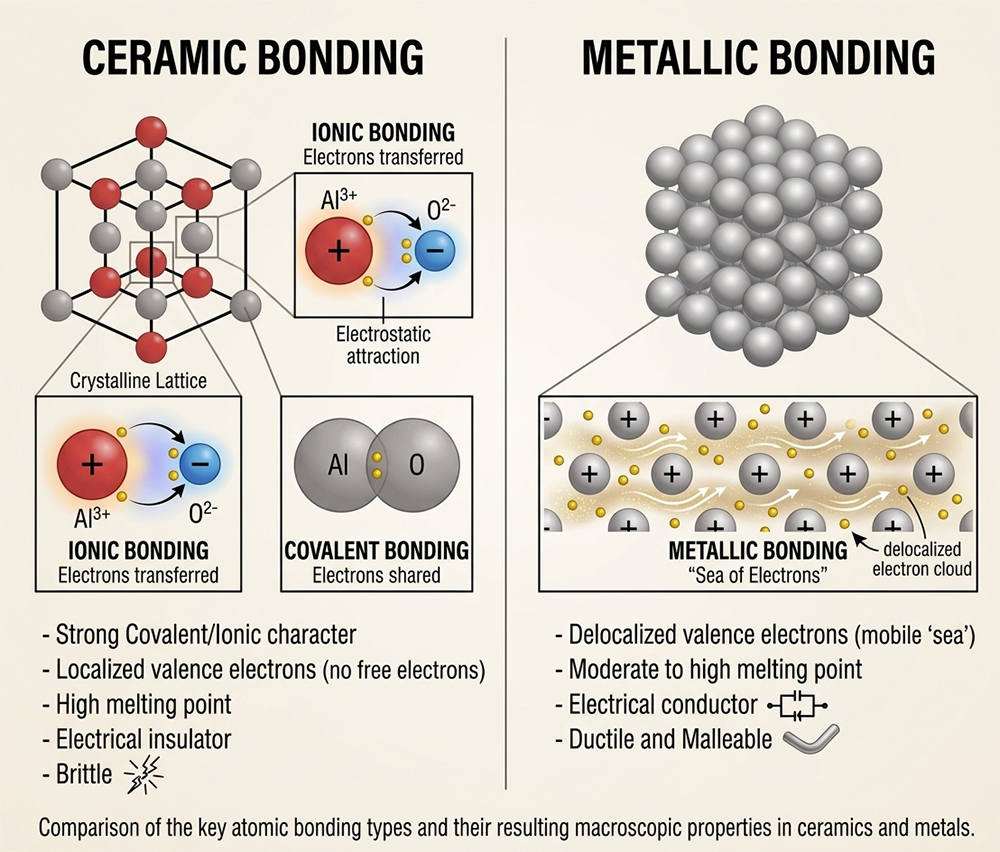
Almost every premature heater failure in the field can be traced back to atomic bonding. How the atoms hold together determines how the material behaves when you crank up the heat—and these differences compound over thousands of hours of operation.
Ceramics are built on incredibly strong covalent and ionic bonds. This gives them exceptionally high bond energy and low atomic diffusion rates. In practice, this means the crystal structure of a ceramic remains highly stable even when pushed close to its melting point. They resist creep, sagging, and the microscopic phase changes that slowly destroy elements under load.
Metals rely on metallic bonding. When you run a metal wire at elevated temperatures, its grain boundaries begin to migrate and grow. This grain growth softens the material, leading to mechanical sagging, warping, and eventual fatigue failure. This is especially true if your application involves constant thermal cycling.
But the most consequential difference is how they handle oxidation.
Ceramics form a micro-thin, dense oxide layer (such as silicon dioxide on silicon carbide, or aluminum oxide on aluminum nitride) when exposed to oxygen at high heat. This layer passivates the surface. It blocks further oxygen from penetrating the material, making the protective mechanism entirely self-limiting.
Metals, by contrast, oxidize in a consumptive manner. The oxide scale on a metal wire grows, cracks, and flakes off over time. This progressively reduces the wire's effective cross-sectional area. As the wire thins, its electrical resistance spikes, creating localized hot spots that eventually burn out the element.
To keep your design safe, keep these continuous operating temperature ceilings in mind:
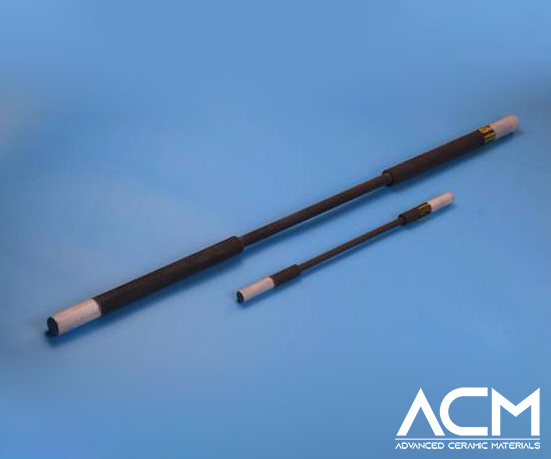
- Silicon Carbide (SiC): ~1700°C
- Molybdenum Disilicide (MoSi₂): ~1900°C
- Pyrolytic Boron Nitride (PBN): ~1600°C
- Aluminum Nitride (AlN): ~600°C
- Nickel-Chromium (Ni-Cr): ~1200°C
- Iron-Chromium-Aluminum (Fe-Cr-Al): ~1400°C
2. Performance Factors That Actually Affect Your Design
Instead of listing generic advantages, let's look at five practical engineering parameters that will directly impact your machine's real-world performance.
2.1 Ramp Rate (Heating Speed)
If your application requires fast, repeatable thermal cycles, ceramic elements are hard to beat. Aluminum nitride-based metal ceramic heaters can comfortably achieve ramp rates of 50°C to 100°C per second. Because the electrical circuit is printed and co-fired directly inside a highly thermal-conductive ceramic substrate, the thermal mass is incredibly low.
Metallic elements require a much bulkier setup. They have to heat up their own bulk mass plus whatever heavy ceramic insulation or support structure they are wrapped around. If you are designing a medical thermal cycler where cycle times directly dictate patient throughput, those extra seconds add up fast. For continuous, steady-state conveyor furnaces, this parameter matters far less.
2.2 Resistance Temperature Coefficient
This is an area where ceramics offer a unique physical property that metals simply cannot replicate.
Barium titanate-based Positive Temperature Coefficient (PTC) ceramics exhibit a giant positive temperature coefficient effect near their Curie point. Within a narrow temperature band, their resistance can shoot up by several orders of magnitude (often greater than 10,000%).
This makes the material entirely self-limiting. As the heater gets hot, its resistance spikes, instantly choking off the current and stabilizing the temperature. It regulates itself without requiring external thermocouples, solid-state relays, or PID controllers.
Metals like nickel-chromium have a positive but mostly linear coefficient. They cannot self-regulate. If your control loop fails or a relay sticks closed, a metal element will keep pulling current until it melts. If you want to build a fail-safe system or simplify your control electronics, PTC ceramics are your best bet.
2.3 Long-Term Resistance Drift
Every heating element drifts in resistance over thousands of hours of operation. What matters is how much it drifts, and how that affects your power delivery.
Because of their stable crystal lattice, high-quality ceramic elements typically drift less than 5% per year. The minor drift that does occur is usually from contact degradation, not the core material.
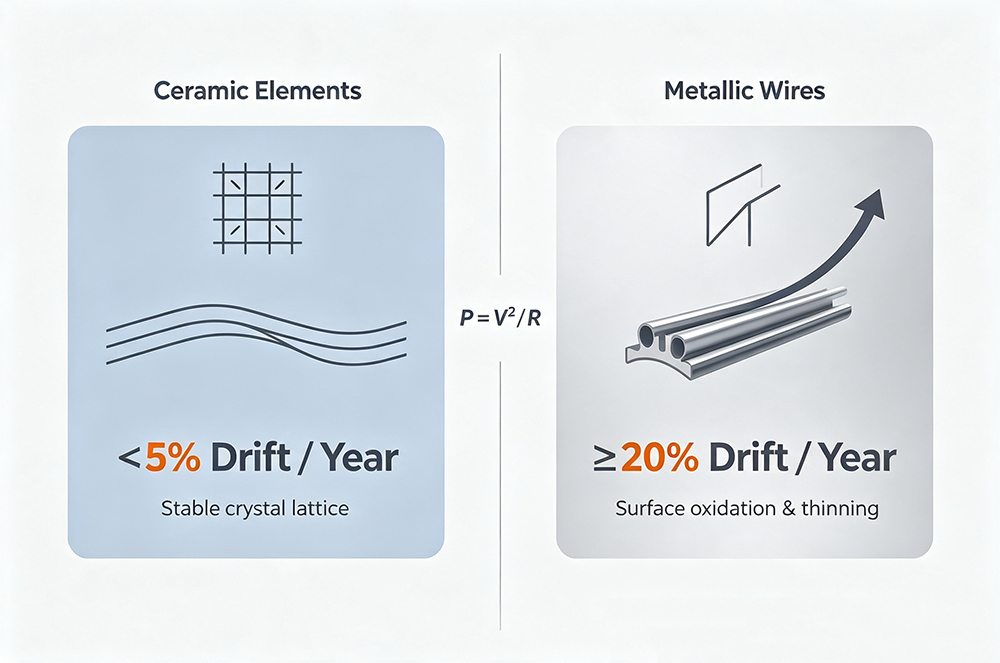
Metallic wires, however, routinely drift by 20% or more annually due to continuous surface oxidation and wire thinning. Since power equals voltage squared divided by resistance (), a 20% increase in resistance drops your power output by about 17%. In precision processes like semiconductor fabrication or analytical chemistry, this power drop results in ruined batches and constant recalibration downtime.
2.4 Chemical Purity / Outgassing
If you are designing high-vacuum or cleanroom systems, outgassing is your enemy.
Pyrolytic boron nitride and aluminum nitride can be produced to extremely high purities (99.99% or higher). They exhibit zero measurable outgassing in high vacuum even at maximum operating temperatures.
Metals, even high-end alloys, can react with process gases like halogens, sulfur, or ammonia. These reactions create volatile compounds that vaporize and coat your chambers, destroying process yields and creating microscopic particles.
2.5 Resistivity Tuning
When you work with metals, your electrical resistance is locked to the physical dimensions of the wire. A standard nickel-chromium alloy has a fixed resistivity. If you need a specific resistance within a tight footprint, your only option is to change the wire length or thickness, which is a major design headache.
Ceramics allow us to dope the raw material during manufacturing. We can tune the bulk resistivity of the material to meet your exact power density needs while keeping the physical footprint of the heater identical.
3. The Decision Matrix: Which One Specs Into Your Next Project?
To make this practical, here is a breakdown of which materials suit which application scenarios, and where sticking with traditional metal actually makes sense.
| Application Scenario | Recommended Material | Why |
|---|---|---|
| Semiconductor MOCVD / PVD chambers | Pyrolytic Boron Nitride composite | 99.999% purity, zero outgassing, and stable performance up to 1600°C. Vital for thin-film quality. |
| High-temperature vacuum / sintering | Molybdenum Disilicide or Silicon Carbide | Able to handle temperatures up to 1900°C. MoSi₂ forms a self-healing silicon dioxide layer that protects it from oxidation. |
| EV battery & cabin thermal systems | Positive Temperature Coefficient | Intrinsic self-regulation. It cannot overheat, eliminating the need for bulky safety thermostats. |
| Medical and analytical diagnostics | Aluminum Nitride | Heats to 500°C in under 5 seconds with excellent temperature uniformity. Compact and highly precise. |
| Handheld consumer styling tools | Aluminum Nitride or Positive Temperature Coefficient | Light, responds instantly to power inputs, and safely survives dry-heat conditions without burning out. |
4. Total Cost of Ownership — Not Just Unit Price
A common mistake I see procurement departments make is comparing only the upfront unit price. If you only look at the purchase order, metal wire always looks better. But for an industrial tool or commercial machine, the correct calculation is Total Cost of Ownership.
We calculate this using a straightforward practical formula:
Total Cost of Ownership = Acquisition Cost + (Energy Cost × Service Years) + (Downtime Cost × Failure Rate × Service Years
When you run the numbers based on real-world industrial furnace operations, the financial picture shifts dramatically.
Ceramic elements typically run at over 95% thermal efficiency because they have low thermal mass and transfer heat directly. Metal wires lose a significant amount of heat to the ambient air and heavy mounting structures, dropping their efficiency to between 70% and 85%.
Additionally, mature ceramic heaters exhibit failure rates well under 1% per year, whereas metal elements run a 5% to 10% annual failure rate due to hot spots and open circuits.
As a rule of thumb: if your equipment runs more than four hours a day, the energy savings and avoided maintenance downtime of a ceramic element will fully recover its upfront price premium within the first year of operation.
5. Practical Next Steps for Your Engineering Team
Wherever you are in your design cycle, there is a practical path forward.
You're in early-stage R&D.
Order a small set of standard AlN (MCH) or PTC samples. Run your own thermal profiles on the bench — test ramp rates, uniformity, and cycling behavior under your actual operating conditions. The data will tell you more than any spec sheet.
You're retrofitting an existing metal-wire machine.
Send us your current wattage, voltage, operating temperature, and envelope dimensions. In many cases, we can design a ceramic replacement that drops into your existing mounting with minimal mechanical changes — and extends your service life immediately.
You're operating above 1600°C or in deep vacuum.
Skip metals entirely. You are already in ceramic-only territory. Contact a specialty materials partner who can design custom PBN or SiC elements for your specific chamber geometry and thermal profile.
At Advanced Ceramic Materials (ACM), we don't believe in one-size-fits-all heating. We work with engineering teams to match exact material properties to your specific temperature and environment requirements. Let's start with a small-batch pilot run so you can validate the performance on your own test bench. Contact us at any time.
References
-
Kingery, W. D., Bowen, H. K., & Uhlmann, D. R. (1976). Introduction to Ceramics (2nd ed.). Wiley-Interscience. — Foundational text on ceramic bonding, diffusion, and high-temperature behavior.
-
Callister, W. D., & Rethwisch, D. G. (2018). Materials Science and Engineering: An Introduction (10th ed.). Wiley. — Standard reference for metallic bonding, grain growth, and thermal degradation.
-
ASTM B76-90 (Reapproved 2021). Standard Test Method for Accelerated Life of Nickel-Chromium Alloys for Electrical Heating. ASTM International. — Accelerated life testing protocol for metallic heating wires; documents oxidation-driven resistance drift.
-
ASTM F2182-19. Standard Test Method for Measurement of the Dielectric Properties of Ceramic Materials. ASTM International. — Dielectric and stability testing for ceramic materials.
-
ASTM E1559-09 (Reapproved 2016). Standard Test Method for Contamination Outgassing Characteristics of Spacecraft Materials. ASTM International. — RGA-based outgassing measurement protocol, applicable to high-vacuum components.
-
Jaffe, B., Cook, W. R., & Jaffe, H. (1971). Piezoelectric Ceramics. Academic Press. — Definitive reference on PTC behavior in BaTiO₃-based ceramics.
-
Schick, H. L. (1966). Thermodynamics of Certain Refractory Compounds. Academic Press. — Thermodynamic data on MoSi₂ oxidation behavior and SiO₂ passivation layer formation.
-
IEC 60751 (2022). Industrial Platinum Resistance Thermometers and Platinum Temperature Sensors. International Electrotechnical Commission. — Temperature measurement standards; used for temperature ceiling references.
-
SEMI E10-0304. Specification for the Measurement of Equipment Reliability, Availability, and Maintainability (RAM). SEMI International. — Semiconductor industry standard for equipment performance metrics (referenced for chamber purity and uptime requirements).
-
SAE J2929 (2023). Electric and Hybrid Vehicle Propulsion Battery Systems Safety Standard. SAE International. — Automotive safety standard referencing PTC-based thermal management.
-
UL 859 (2018). Standard for Safety of Household Electric Personal Grooming Appliances. Underwriters Laboratories. — Consumer appliance safety standard (referenced for portable heater applications).
-
ASM Handbook, Volume 18 (1992). Friction, Lubrication, and Wear Technology. ASM International. — Compilation of industrial field data on heating element failure rates and energy efficiency.

{{item.content}}
LEVE A REPLY
{{item.children[0].content}}
{{item.content}}
LEAVE A REPLY
SUBSCRIBE OUR NEWSLETTER
- Ceramic Heating Coil Versus Cotton Coil: Choosing the Better Fit
- 5 Ways Alumina Ceramic Plates Keep Heavy Industry Running
- Oxide, Sulfide, or Phosphate? A Supplier's Guide to Solid-State Electrolyte Ceramics
- Alumina vs. Zirconia Ceramics: The Engineering Blueprint for Material Selection
- Case Study: Sub-Millimeter Sapphire Tubes for High Voltage Discharge Applications
 Alumina Powder (Al2O3): A Technical Guide to Grades, Properties, and Applications
How to choose alumina powder purity from 92% to 99.99%. ACM guide covers decision tree, properties, ZTA, and application tables for engineers.
READ MORE >
Alumina Powder (Al2O3): A Technical Guide to Grades, Properties, and Applications
How to choose alumina powder purity from 92% to 99.99%. ACM guide covers decision tree, properties, ZTA, and application tables for engineers.
READ MORE >
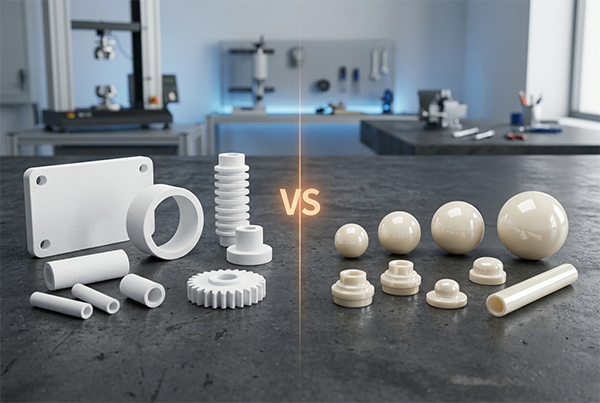 Alumina vs. Zirconia Ceramics: The Engineering Blueprint for Material Selection
This article compares their physical properties, real-world trade-offs, and cost-benefit realities to help you select the right ceramic for your operating environment.
READ MORE >
Alumina vs. Zirconia Ceramics: The Engineering Blueprint for Material Selection
This article compares their physical properties, real-world trade-offs, and cost-benefit realities to help you select the right ceramic for your operating environment.
READ MORE >
 Oxide, Sulfide, or Phosphate? A Supplier's Guide to Solid-State Electrolyte Ceramics
Oxide, sulfide, or phosphate? A practical guide to solid-state electrolyte ceramics from a supplier who handles them daily. Compare LLZO, LATP, and LGPS on conductivity, processing, stability, and real-world viability.
READ MORE >
Oxide, Sulfide, or Phosphate? A Supplier's Guide to Solid-State Electrolyte Ceramics
Oxide, sulfide, or phosphate? A practical guide to solid-state electrolyte ceramics from a supplier who handles them daily. Compare LLZO, LATP, and LGPS on conductivity, processing, stability, and real-world viability.
READ MORE >