





Case Study: Sub-Millimeter Sapphire Tubes for High Voltage Discharge Applications
Project Background
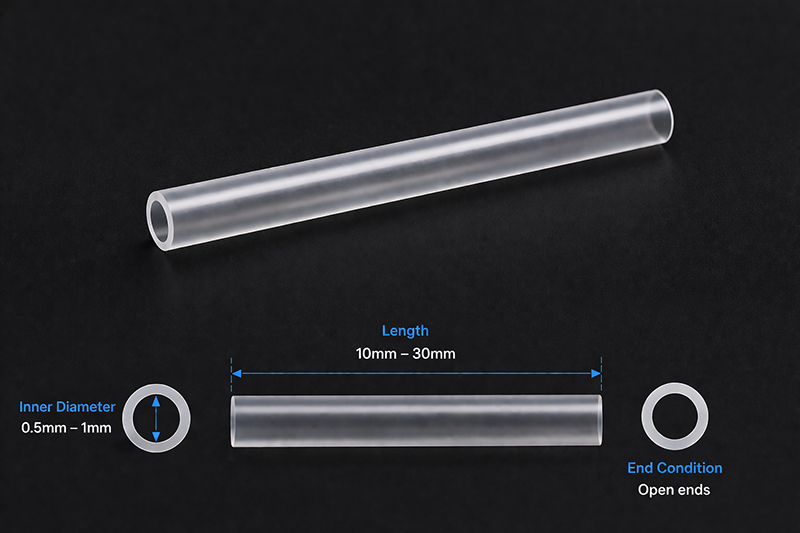
A US-based R&D company was developing a high voltage discharge capillary system for an advanced research project. The system required an insulating tube with an inner diameter of 0.5 to 1mm, a length of 10 to 30mm, and open ends. The tube would be subjected to repeated high voltage discharges, so dielectric strength and surface integrity were critical.
The customer evaluated several material options including polymers, glass, and standard ceramics. Polymers were ruled out due to degradation under repeated discharges. Glass lacked the required mechanical strength. Standard ceramics could not achieve the needed surface finish at sub-millimeter dimensions.
The customer selected sapphire (Al2O3). Sapphire offers high dielectric strength, excellent thermal stability, and superior surface hardness, making it suitable for extreme electrical environments.
Initial Challenges
The customer approached multiple ceramic suppliers before contacting Advanced Ceramic Materials (ACM). Most declined the project. A few attempted to provide samples but could not meet the specifications.
The primary obstacle was manufacturing sapphire tubes with a sub-millimeter ID. Conventional drilling processes for sapphire become unreliable when the diameter drops below 1mm. Drill bits break. Cracks form. The inner surface often comes out rough.
Drawing techniques work better for small diameters, but holding consistent wall thickness and ID tolerance across a 10-30mm length is difficult. Any variation in wall thickness creates weak points that can fail under high voltage.
Two additional requirements made the project more demanding.
Dielectric strength. The tube needed to withstand repeated high voltage discharges without dielectric breakdown. Any micro-crack, inclusion, or surface imperfection can create a failure point. Under high voltage, the defect site experiences localized field enhancement. Temperature rises. Eventually, the material breaks down. For the customer's R&D timeline, a single tube failure would set back testing by weeks.
Surface finish. The inner surface needed to be exceptionally smooth. Rough surfaces trap contaminants. They also create localized electric field enhancements. Both conditions increase the risk of premature breakdown. The challenge is that polishing a 0.5mm ID tube after manufacturing is not practical. No tool fits inside. The finish must be achieved through the manufacturing process itself.
The customer provided a sample from a previous supplier attempt. Inspection revealed visible striations on the inner wall and micro-cracks along the length. These defects explained the test failures they had experienced.
ACM's Approach
Advanced Ceramic Materials (ACM) used an advanced drawing process specifically developed for sub-millimeter sapphire tubes. This process controls wall thickness in real time, reducing variation along the tube length.
A post-processing surface treatment was also applied. This step removes micro-cracks and smooths the inner wall without mechanical contact. It is not standard among ceramic suppliers, but ACM has found it necessary for high voltage applications.
Specifications delivered:
| Parameter | Value |
|---|---|
| Material | Sapphire (Al2O3) |
| Inner Diameter | 0.5mm – 1mm |
| Length | 10mm – 30mm |
| End Condition | Open ends |
| Dielectric Strength | Passed customer voltage requirement |
Each tube was inspected before shipment. Wall thickness variation was held under 0.03mm. Surface roughness measured below the customer's threshold. No cracks or inclusions were found.
Results
The first batch was shipped within four weeks of the order. The customer integrated the tubes into the high voltage discharge system and completed a full test cycle. No dielectric breakdown occurred. No surface-related failures were reported.
The customer confirmed that the tubes met the specifications and that the project could proceed to the next phase.
Since the initial order, the customer has placed two additional orders. The second order was for 50 pieces (up from 15 pieces in the initial order). The third order added a custom length option—20mm and 25mm instead of the original 15mm—for different test configurations.
Summary
Sub-millimeter sapphire tubes are difficult to manufacture, which is why most suppliers avoid these requests. For high voltage discharge applications, however, sapphire is often the only material that works.
The key requirements are precise ID tolerance and a smooth inner surface. Achieving both requires control over the drawing process and appropriate post-processing. Doing one without the other leads to failures.
Contact
Advanced Ceramic Materials (ACM) manufactures sapphire and alumina tubes with IDs down to 0.5mm. Custom lengths and high dielectric strength are available.
Contact us with your specifications for a technical consultation and quote.

{{item.content}}
LEVE A REPLY
{{item.children[0].content}}
{{item.content}}
LEAVE A REPLY
SUBSCRIBE OUR NEWSLETTER
- Oxide, Sulfide, or Phosphate? A Supplier's Guide to Solid-State Electrolyte Ceramics
- Alumina vs. Zirconia Ceramics: The Engineering Blueprint for Material Selection
- Alumina Powder (Al2O3): A Technical Guide to Grades, Properties, and Applications
- Ceramic Machining: Essential Techniques and Processes for Precise Components
- The Melting Behavior of Ceramics: A Technical Guide for High-Temperature Applications
 Case Study: Replacing Alumina Tubes with Mg-Stabilized Zirconia to Meet 1850°C Demands
This case study underscores the importance of material selection in high-temperature process safety. ACM's expertise in material solutions and custom-tailored approaches helped the client successfully upgrade to magnesium-stabilized zirconia tubing, ensuring reliable operation at extreme temperatures.
READ MORE >
Case Study: Replacing Alumina Tubes with Mg-Stabilized Zirconia to Meet 1850°C Demands
This case study underscores the importance of material selection in high-temperature process safety. ACM's expertise in material solutions and custom-tailored approaches helped the client successfully upgrade to magnesium-stabilized zirconia tubing, ensuring reliable operation at extreme temperatures.
READ MORE >
 Thermal Management in Power Electronics with Hexagonal Boron Nitride
Purity alone doesn't guarantee performance—especially under real-world thermal cycling. By shifting to high-purity h-BN, the client gained not just higher heat dissipation and electrical reliability, but also production and integration advantages.
READ MORE >
Thermal Management in Power Electronics with Hexagonal Boron Nitride
Purity alone doesn't guarantee performance—especially under real-world thermal cycling. By shifting to high-purity h-BN, the client gained not just higher heat dissipation and electrical reliability, but also production and integration advantages.
READ MORE >
 Boron Nitride Coatings: The Solution for Molten Metal Applications
This article explains how boron nitride coatings protect industrial equipment from the harsh effects of molten metals. It covers thermal insulation, oxidation prevention, wetting control, and other key defense mechanisms.
READ MORE >
Boron Nitride Coatings: The Solution for Molten Metal Applications
This article explains how boron nitride coatings protect industrial equipment from the harsh effects of molten metals. It covers thermal insulation, oxidation prevention, wetting control, and other key defense mechanisms.
READ MORE >