





The Melting Behavior of Ceramics: A Technical Guide for High-Temperature Applications
When engineers specify materials for extreme environments, few properties matter more than how a material behaves at its upper thermal limits. For ceramics, this behavior is more complex than a simple solid-to-liquid transition.
This technical guide reviews how advanced ceramics melt. It gives key basics to help you pick materials for high-heat processes. It covers uses from furnace construction to semiconductor manufacturing.
Understanding Ceramic Melting: Not Always a Simple Transition
Contrary to a common misconception, most ceramics do indeed melt—but the process differs significantly from metals.
A pure metal has a well-defined melting point where the solid phase transforms completely into a liquid. Ceramics, however, are often multi-phase materials with complex crystal structures held together by strong ionic and covalent bonds. When heated:
- Oxide ceramics (like alumina and magnesia) typically have true melting points, though they may soften over a narrow temperature range.
- Non-oxide ceramics (like silicon carbide) often decompose at high temperatures before reaching a theoretical melting point.
- Glass-forming ceramics (like silica) gradually soften into a viscous state over a temperature range, a phenomenon known as glass transition.
This distinction matters for engineering design. A furnace lining material that softens gradually behaves very differently from one that maintains structural integrity until decomposition.
At Advanced Ceramic Materials (ACM), we classify materials based on their precise thermal behavior, ensuring our customers select ceramics matched to their actual operating conditions.
Melting Points of Common Engineering Ceramics
The table below presents melting (or decomposition) temperatures for ceramics commonly used in industrial applications. Values represent either the melting point (where congruent melting occurs) or the upper use limit before decomposition.
| Material | Formula | Melting/Decomposition Temp (°C) | Temp (°F) |
|---|---|---|---|
| Hafnium Carbide | HfC | 3958 | 7156 |
| Tantalum Carbide | TaC | 3768 | 6814 |
| Titanium Carbide | TiC | 3160 | 5720 |
| Zirconium Diboride | ZrB₂ | 3245 | 5873 |
| Titanium Diboride | TiB₂ | 3225 | 5837 |
| Magnesium Oxide (Magnesia) | MgO | 2800 | 5072 |
| Silicon Carbide | SiC | 2730 (decomposes) | 4946 |
| Zirconium Oxide (Zirconia) | ZrO₂ | 2715 | 4919 |
| Tantalum Nitride | TaN | 2700 | 4892 |
| Aluminum Nitride | AlN | 2200 | 3992 |
| Aluminum Oxide (Alumina) | Al₂O₃ | 2072 | 3761 |
| Silicon Nitride | Si₃N₄ | 1900 (decomposes) | 3452 |
| Mullite | 3Al₂O₃·2SiO₂ | 1850 | 3362 |
| Fused Silica | SiO₂ | 1713 | 3115 |
| Porcelain | - | 1700-1800 | 3092-3272 |
Note: Ultra-high temperature ceramics (UHTCs) like HfC and TaC handle the highest heat. This makes them vital in extreme settings, such as rocket nozzle inserts and hypersonic vehicle leading edges.
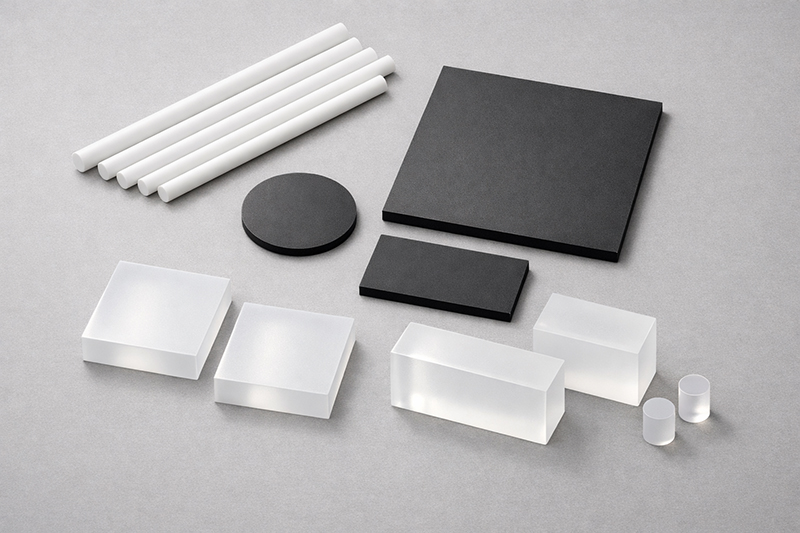
Factors That Influence Thermal Stability
Understanding a number from a table is only the first step. Several factors determine how a ceramic component will actually perform at elevated temperatures:
1. Purity and Grain Boundary Phases
Impurities often concentrate at grain boundaries and can form low-melting-point phases that compromise performance well below the bulk material's theoretical melting point. This is why ACM emphasizes high-purity starting materials—to eliminate weak links in the microstructure.
2. Atmosphere
Oxides like alumina are stable in oxidizing environments but may react in reducing atmospheres. Non-oxides like silicon carbide form protective oxide layers in air but may actively decompose in vacuum or hydrogen at elevated temperatures.
3. Thermal Shock Resistance
A high melting point does not guarantee resistance to thermal shock. Materials with low thermal expansion and high thermal conductivity, like silicon carbide, handle rapid temperature changes well. Materials with high expansion, like magnesia, handle rapid changes worse, even if they melt later.
Selecting Ceramics by Thermal Requirements
The melting behavior of a ceramic directly determines its suitability for specific applications. Here is how engineers at Advanced Ceramic Materials approach material selection:
For Continuous High-Temperature Processing
When designing furnaces, kilns, or high-temperature reactors, the working temperature must remain comfortably below the material's melting or softening point. Alumina (2072°C) serves reliably up to 1750°C in many applications, while magnesia (2800°C) can be used above 2000°C in appropriate environments.
For Thermal Barriers and Insulation
Not all high-temperature applications require fully dense ceramics. Porous insulating firebrick or ceramic fiber boards use the same high melting points with lower thermal conductivity. They protect structural parts and reduce energy loss.
For Extreme Environments
Applications such as crucibles for melting reactive metals or components exposed to plasma in fusion reactors require materials that maintain integrity at the edge of thermal stability. Ultra-high temperature ceramics like zirconium diboride and hafnium carbide, available through ACM, are engineered specifically for these demanding conditions.
For Precision Manufacturing
In semiconductor processing and LED fabrication, ceramics like aluminum nitride (2200°C melting point) are chosen not only for thermal stability but also for thermal conductivity. AlN dissipates heat while maintaining dimensional stability at the elevated temperatures used in chemical vapor deposition and other processes.
Thermal Shock: The Hidden Limitation
A frequently overlooked aspect of high-temperature ceramic performance is resistance to thermal shock—the ability to survive rapid temperature changes.
Even a ceramic with an extraordinarily high melting point can crack if subjected to sudden heating or cooling. The stress arises from temperature gradients within the component; one area expands while another resists, generating internal stress that exceeds the material's strength.
Materials with:
- High thermal conductivity (like silicon carbide or beryllium oxide)
- Low thermal expansion (like fused silica or cordierite)
- High fracture toughness (like partially stabilized zirconia)
generally exhibit better thermal shock resistance. This is why ACM engineers often guide customers toward silicon carbide for applications involving rapid heating cycles, even when other materials might offer higher absolute melting points.
Conclusion: Thermal Data as a Design Tool
The melting point of a ceramic is not merely a number—it is the upper boundary of a material's operating envelope. By knowing not only where that boundary is, but how a material reaches it, engineers can make informed choices. These choices balance performance, reliability, and cost.
At Advanced Ceramic Materials (ACM), we provide the technical data and high-purity ceramic materials necessary to push the boundaries of high-temperature engineering. Whether your application requires the extreme stability of hafnium carbide or the thermal shock resistance of silicon carbide, our team helps match material properties to process requirements.
For detailed specifications or assistance with material selection, contact our engineering team.
Frequently Asked Questions
1. What is the highest melting point ever recorded for a ceramic?
Hafnium carbide (HfC) and tantalum carbide (TaC) form solid solutions with melting points exceeding 4000°C, among the highest known for any material. The HfC-TaC system has reported melting points near 4200°C under ideal conditions.
2. At what temperature do ceramics typically fail from thermal shock?
There is no universal temperature—failure depends on the material's thermal expansion coefficient, thermal conductivity, fracture toughness, and the severity of the temperature gradient. Some cordierite ceramics survive quenching from 1000°C, while others crack with a 200°C differential.
3. Why do some ceramics decompose before melting?
Materials like silicon carbide (SiC) and silicon nitride (Si₃N₄) have high vapor pressures or chemical instabilities at elevated temperatures. Rather than melting, they dissociate into their constituent elements or form different compounds. This is why they are typically used in inert atmospheres or with protective coatings at very high temperatures.
4. Can ceramic materials be used above their melting point?
No—once a ceramic reaches its melting or decomposition temperature, it loses structural integrity. However, some applications (like thermal protection systems during re-entry) rely on ablative cooling, where the surface material intentionally melts or vaporizes to carry away heat.
5. How do impurities affect ceramic melting behavior?
Impurities can significantly depress melting points by forming eutectic phases at grain boundaries. This is why high-purity ceramics command a premium for extreme-temperature applications—they eliminate low-melting-point phases that would otherwise limit performance.

{{item.content}}
LEVE A REPLY
{{item.children[0].content}}
{{item.content}}
LEAVE A REPLY
SUBSCRIBE OUR NEWSLETTER
- Oxide, Sulfide, or Phosphate? A Supplier's Guide to Solid-State Electrolyte Ceramics
- Alumina vs. Zirconia Ceramics: The Engineering Blueprint for Material Selection
- Case Study: Sub-Millimeter Sapphire Tubes for High Voltage Discharge Applications
- Alumina Powder (Al2O3): A Technical Guide to Grades, Properties, and Applications
- Ceramic Machining: Essential Techniques and Processes for Precise Components
 Alumina Powder (Al2O3): A Technical Guide to Grades, Properties, and Applications
How to choose alumina powder purity from 92% to 99.99%. ACM guide covers decision tree, properties, ZTA, and application tables for engineers.
READ MORE >
Alumina Powder (Al2O3): A Technical Guide to Grades, Properties, and Applications
How to choose alumina powder purity from 92% to 99.99%. ACM guide covers decision tree, properties, ZTA, and application tables for engineers.
READ MORE >
 Alumina vs. Zirconia Ceramics: The Engineering Blueprint for Material Selection
This article compares their physical properties, real-world trade-offs, and cost-benefit realities to help you select the right ceramic for your operating environment.
READ MORE >
Alumina vs. Zirconia Ceramics: The Engineering Blueprint for Material Selection
This article compares their physical properties, real-world trade-offs, and cost-benefit realities to help you select the right ceramic for your operating environment.
READ MORE >
 Oxide, Sulfide, or Phosphate? A Supplier's Guide to Solid-State Electrolyte Ceramics
Oxide, sulfide, or phosphate? A practical guide to solid-state electrolyte ceramics from a supplier who handles them daily. Compare LLZO, LATP, and LGPS on conductivity, processing, stability, and real-world viability.
READ MORE >
Oxide, Sulfide, or Phosphate? A Supplier's Guide to Solid-State Electrolyte Ceramics
Oxide, sulfide, or phosphate? A practical guide to solid-state electrolyte ceramics from a supplier who handles them daily. Compare LLZO, LATP, and LGPS on conductivity, processing, stability, and real-world viability.
READ MORE >