Do you have any questions? Email Us
[email protected]







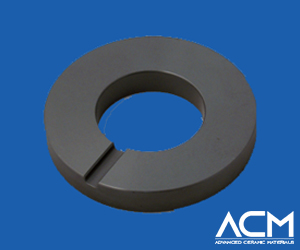
SC0894 Silicon Carbide Seal Ring, SiC Seal Ring
- Catalog No. SC0894
- Molecular Formula SiC
- Molecular Weight 40.1
- Appearance Black
- Melting Point 2,730° C (4,946° F) (decomposes)
- Density 3.0 to 3.2 g/cm3
- Electrical Resistivity 1 to 4 10x Ω-m
- Poisson's Ratio 0.15 to 0.21
- Specific Heat 670 to 1180 J/kg-K
Datasheet
Inquiry
SC0894 Silicon Carbide Seal Ring, SiC Seal Ring
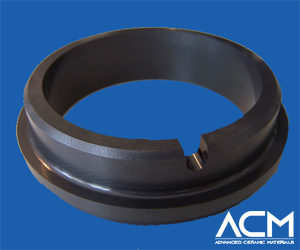
Silicon Carbide Seal Ring Description
Silicon Carbide (SiC) seal rings from Advanced Ceramic Materials (ACM) are precision-engineered components for demanding dynamic sealing applications. Designed for mechanical seals in centrifugal pumps, agitators, mixers, and rotary shaft equipment, these rings deliver exceptional wear resistance, low friction, and reliable performance under high sliding velocities and severe operating conditions.
As one of the hardest and most chemically inert ceramic materials available, silicon carbide is the industry standard for mechanical seal faces that must withstand abrasive slurries, corrosive chemicals, and high-pressure differentials. ACM's SiC seal rings are precision ground to tight dimensional tolerances with surface finishes achieving Ra ≤ 0.2µm – critical for minimizing leakage and maximizing seal face life in rotating equipment.
Silicon Carbide Seal Ring Specifications
| Physical Property | Value |
|---|---|
| Material | Silicon Carbide (SiC) |
| Color | Black |
| Density | 3.0 – 3.2 g/cm³ |
| Hardness | Hv ≥ 26 GPa (S-SiC) / Hv ≥ 20 GPa (RB-SiC) |
| Melting Point | 2730°C (decomposes) |
| Max. Service Temp (Oxidizing) | 1600°C (S-SiC) / 1350°C (RB-SiC) |
| Max. PV Value | Consult ACM for grade-specific ratings |
| Electrical Resistivity | 1 – 4 × 10⁻² Ω·m |
| Poisson's Ratio | 0.15 – 0.21 |
| Specific Heat | 670 – 1180 J/kg·K |
| Typical Surface Finish | Ra ≤ 0.2µm (lapping/lapping) |
Available Grades – Selection Guide for Mechanical Seals
| Type | Grade | Description | Purity | Hardness | Best Suited For |
|---|---|---|---|---|---|
| Sintered SiC (S-SiC) | SMB1 | Pure sintered SiC | > 98% | Hv 26 GPa | Corrosive and high-temperature seal faces |
| Sintered SiC (S-SiC) | SMG1 | Graphite-impregnated S-SiC | > 98% | Hv 23 GPa | Dry-running or poorly lubricated seals |
| Sintered SiC (S-SiC) | SMP1 | Porous S-SiC | > 98% | Hv 24 GPa | Specialty sealing applications |
| Reaction-Bonded SiC (RB-SiC) | SMB2 | Basic RB-SiC | > 88% | Hv 20 GPa | High PV value mechanical seals |
| Reaction-Bonded SiC (RB-SiC) | SMG2 | Graphite-impregnated RB-SiC | > 88% | Hv 18 GPa | Low-friction seals in marginal lu |
Profiles Available
ACM offers silicon carbide seal rings in a variety of configurations to suit different mechanical seal designs:
- Flat Seal Rings – Standard face seals for general-purpose mechanical seals
- Single-Step Seal Rings – Designed for cartridge and component seal assemblies
- Double-Step Seal Rings – For balanced and high-pressure mechanical seals
- Custom Profiles – Engineered to customer-provided drawings and specifications
Silicon Carbide Seal Ring Applications
- Centrifugal Pumps – Mechanical seal faces for chemical, refinery, and water treatment pumps
- Agitators & Mixers – Shaft seals for mixing vessels and reactors in corrosive service
- Compressors – Rotary and reciprocating compressor sealing components
- Marine Propulsion – Shaft seals for naval and commercial vessel applications
- Oil & Gas – Seal rings for pipeline pumps and subsea equipment
- Aerospace – High-performance seal faces for aircraft hydraulic systems
Packing Service
ACM’s silicon carbide seal rings are carefully handled to minimize damage during storage and transportation and to preserve the quality of our products in their original condition.
Frequently Asked Questions
What is the maximum PV value for SiC seal rings?
The permissible PV value varies with the specific grade, lubrication conditions, and counterface material. Sintered SiC paired with SiC or tungsten carbide faces can achieve PV values exceeding 10 MPa·m/s under favorable lubrication conditions. Contact ACM with your specific operating parameters for grade recommendations.
What surface finish is required for SiC seal faces?
For reliable sealing performance, ACM recommends a surface finish of Ra ≤ 0.2µm on mating seal faces. Lapped finishes of Ra 0.1µm or finer are available for critical applications requiring minimal leakage.
Sintered SiC vs Reaction-Bonded SiC – which is better for mechanical seals?
Sintered SiC provides superior chemical resistance and hardness, making it the preferred choice for corrosive services and abrasive slurries. Reaction-Bonded SiC offers slightly lower hardness but contains free silicon that improves self-lubricity and fracture toughness – often preferred for high-PV applications where lubrication is marginal.
Can SiC seal rings run against other materials?
Yes. SiC seal faces are commonly paired with SiC (self-mated), tungsten carbide, or alumina ceramics. The ideal counterface material depends on your specific pressure, speed, and fluid conditions.
What grades are available for high-temperature seal applications?
Sintered SiC grades (SMB1, SMG1) are rated for continuous service up to 1600°C in oxidizing atmospheres, making them suitable for high-temperature mechanical seal applications such as hot oil pumps and furnace equipment.
Do you offer custom seal ring designs?
Yes. ACM manufactures custom SiC seal rings to customer specifications, including non-standard dimensions, stepped profiles, and unique surface geometries. Please provide a detailed drawing or sample for quotation.
 Preview
 Download

Request a Quote
-
Attachment (Optional)
No file chosen
Related Products

Tel : (949) 407-8904
Address : 1940 E Deere Ave #100 Santa Ana, CA 92705 U.S.A.
Main Products

Useful Links
Featured Posts