Do you have any questions? Email Us
[email protected]







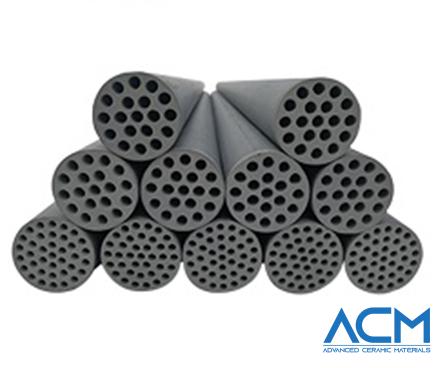
CM3233 Silicon Carbide (SiC) Based Tubular Ceramic Membrane – High-Performance Cross-Flow Filtration
- Catalog No. CM3233
- Material Silicon Carbide (SiC)
- Pore Size 0.8μm, 0.2μm, 100nm, 50nm, 20nm or customized
- Number of Channels 1, 4, 7, 9, 19, 37 or customized
Inquiry
CM3233 Silicon Carbide (SiC) Based Tubular Ceramic Membrane – High-Performance Cross-Flow Filtration
Technical Specifications
Membrane Performance Data
| Parameter | Value |
|---|---|
| Substrate Material | Silicon Carbide (SiC) |
| Pore Size | 0.8μm, 0.2μm, 100nm, 50nm, 20nm or customized |
| Length of Elements | Max. 1200 mm |
| Structure | Symmetric (coatings possible) |
| Configuration | Cylindrical with round channels |
| Temperature Resistance (Air) | Up to 800°C |
| pH Stability | 0-14* |
| Operating Pressure | Max 10 bar TMP (recommended below 3 bar TMP) |
| Maximum Negative TMP | 3 bar |
Channel Configurations & Membrane Areas
| Type | Channels | Length (mm) | Channel Diameter (mm) | Membrane Area (m²) |
|---|---|---|---|---|
| TCM-1 | 1 | 1016 | 7.0 | 0.02 |
| TCM-7A | 7 | 1016 | 6.0 | 0.158 |
| TCM-7B | 7 | 1178 | 6.0 | 0.20 |
| TCM-19A | 19 | 1016 | 4.0 | 0.24 |
| TCM-19B | 19 | 1178 | 3.3 | 0.23 |
| TCM-19C | 19 | 1000 | 6.0 | 0.358 |
| TCM-37A | 37 | 1200 | 2.0 | 0.30 |
| TCM-37B | 37 | 1000 | 3.6 | 0.418 |
Technical Overview
1. Key Advantages of SiC Tubular Ceramic Membrane
- Excellent Chemical Resistance: Outstanding resistance to acids, alkalis, and oxidizing chemicals with pH stability from 0-14.
- High Thermal Stability: Maintains structural integrity up to 800°C in air, suitable for high-temperature filtration processes.
- Solvent Stability: Compatible with a wide range of organic solvents.
- Fine Separability: Narrow pore size distribution ensures precise filtration accuracy.
- Mechanical & Abrasive Resistance: Exceptional durability extends operational lifetime.
- High Permeability: Compact multi-channel geometry optimized for bulk processing applications.
- Long Work Life: Extremely durable construction reduces replacement frequency.
2. Operating Principle – Cross-Flow Filtration
The SiC membrane filtration system operates on a "cross-flow filtration" fluid separation process. The raw material liquid flows at high speed inside the membrane tubes. Driven by pressure, small molecules containing clarified penetrants move outward along the vertical direction through the dense membrane layer. Macromolecular components and turbidity concentrate are intercepted, achieving separation, enrichment, and purification of fluids.
3. Primary Applications
- Biotechnology & Fermentation: Filtration of fermentation broth for amino acids (lysine, threonine) and organic acids (lactic acid, succinic acid).
- Food & Beverage: Clarification and filtration of fruit juices, plant extracts, and beverages.
- Industrial Processing: Concentration of reducing gels and other viscous streams.
- Chemical Processing: Separation and purification of aggressive chemical streams requiring pH and solvent resistance.
- Wastewater Treatment: High-temperature and harsh chemical wastewater filtration.
4. Filtration Capability
SiC tubular ceramic membranes are suitable for microfiltration (MF) and ultrafiltration (UF) applications. The all-SiC construction from support layer to membrane layer ensures superior performance in demanding environments where conventional ceramic membranes (such as alumina or zirconia) may degrade.
Quality Assurance
- Recrystallization technology through high-temperature sintering for uniform pore structure.
- All-SiC construction (support layer, transition layer, and membrane layer).
- Narrow pore size distribution verified through bubble point and porosimetry testing.
- Mechanical integrity testing to ensure pressure rating compliance.
Request a Quote
-
Attachment (Optional)
No file chosen
Related Products

Tel : (949) 407-8904
Address : 1940 E Deere Ave #100 Santa Ana, CA 92705 U.S.A.
Main Products

Useful Links
Featured Posts